TAIPEI, Taiwan—The friendly man who answered my questions had heard about the corn-cooking geyser last week on a TV documentary in Taipei, and had seized the long weekend to check it out with his family. Another woman heard our conversation and piped up with her story. She’d come specifically for the geyser as well. She told us in a hushed voice that it reappears in a different place after every rain, and only the locals know where to dig to find it. No one knows how they know where it will reappear, she said.
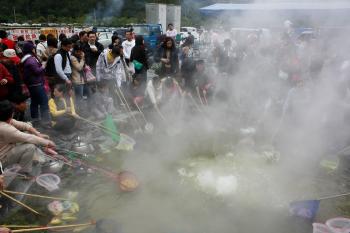
Gathered around the boiling pit of water 10m in diameter were people of all ages. They had brought their own baskets and small nets, or bought them on site, along with corn, eggs, prawns, yams, and whatever else can be boiled. There was no space left for latecomers, and the friendly man said that corn should be expected to take about 45 minutes, while smaller items should be shorter. Then someone commented that the clever people had already dumped their whole, sealed nets into the broth and gone away for a paddle, while everyone else was stuck squatting and waiting. It seemed for many, however, that the excitement of being at the geyser-face more than made up for it.
The shifting geyser regularly attracts several hundred daily visitors and their cars, as well as the regular carnival operators and food stalls, said to be ubiquitous by locals (it is supposed to be cheaper for them to suffer the fines for illegal operation than pay taxes). Around the geyser along one side stood a row of game tents with unusual prizes, along the other the barbeques and food stools, where the nets and corn were also sold. Vans and chairs were scattered randomly around the periphery, where families sat down together to hungrily gnaw through their piping hot spoils taken directly from the pit. Food cooked in the geyser is supposed to taste better and be healthier than regular food, according to the friendly man, who didn’t say where he’d heard that.
Gathered around the boiling pit of water 10m in diameter were people of all ages. They had brought their own baskets and small nets, or bought them on site, along with corn, eggs, prawns, yams, and whatever else can be boiled. There was no space left for latecomers, and the friendly man said that corn should be expected to take about 45 minutes, while smaller items should be shorter. Then someone commented that the clever people had already dumped their whole, sealed nets into the broth and gone away for a paddle, while everyone else was stuck squatting and waiting. It seemed for many, however, that the excitement of being at the geyser-face more than made up for it.
The shifting geyser regularly attracts several hundred daily visitors and their cars, as well as the regular carnival operators and food stalls, said to be ubiquitous by locals (it is supposed to be cheaper for them to suffer the fines for illegal operation than pay taxes). Around the geyser along one side stood a row of game tents with unusual prizes, along the other the barbeques and food stools, where the nets and corn were also sold. Vans and chairs were scattered randomly around the periphery, where families sat down together to hungrily gnaw through their piping hot spoils taken directly from the pit. Food cooked in the geyser is supposed to taste better and be healthier than regular food, according to the friendly man, who didn’t say where he’d heard that.