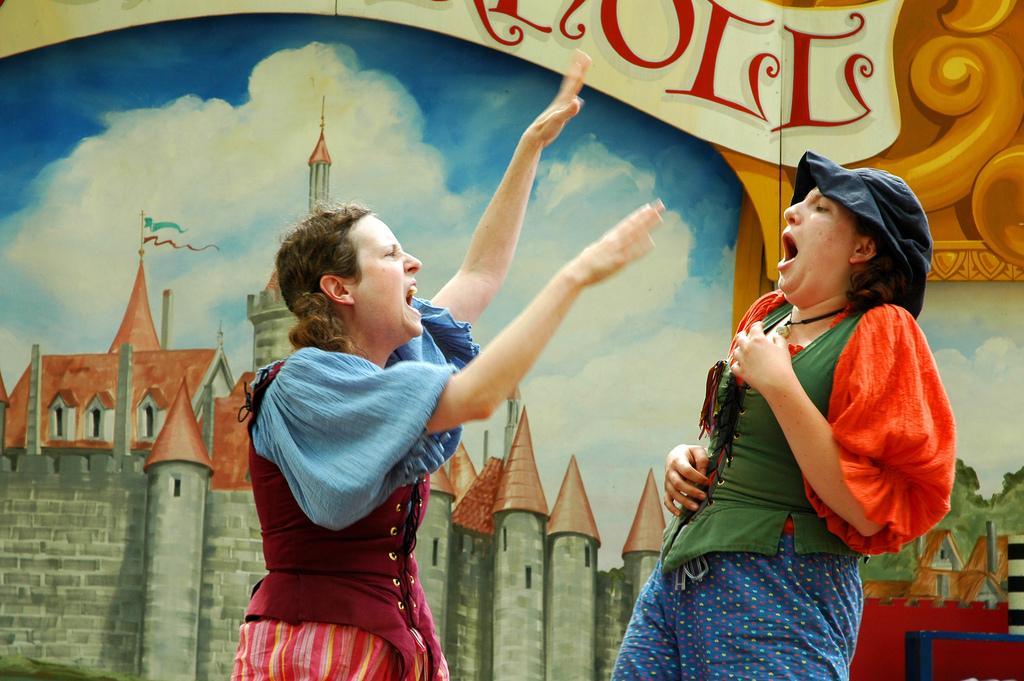
Why does a four-year-old play when a 14-year-old creates? It’s often argued that play is central to the lives of young children. Yet the play of older children and adults is often seen as leisure, escapism or even deviance. As psychologist Erik Erikson puts it: “The playing adult steps sideward into another reality; the playing child advances forward to new stages of mastery.” But there should not be such a binary division between what is educational and what is frivolous.
In my work in theatre education I’ve found playing to be a vital part of teaching young people of all ages, whether playing warm-up games, improvising scenes or exploring new ideas. Yet teachers are often held back by the belief that it’s only young children who are allowed to play.
Ruth Churchill Dower, director of Earlyarts, a network of people working in creative early years professionals, has highlighted the change in language from “play” to “creativity” as we talk of older children’s education. She points out that “play” is often seen as open-ended and egalitarian, while “creativity” is more associated with particular skills and “seems to sit higher in the unspoken hierarchy”.
Who’s Being Playful?
I wanted to find out whether we lose something when we stop talking about play in the education of older children. It was this question which prompted my current and ongoing, doctoral research, carrying out case studies of school classes taking part in Shakespeare Schools’ Festival. I followed six groups through rehearsal to the final performance looking at whether they play as they work together and if it’s relevant.
Researchers have always found “play” notoriously difficult to define. Developmental definitions, which dominate early years work, centre around a taxonomy of play devised by veteran playworker Bob Hughes, which details 15 types of playing. These include categories such as rough and tumble play, social play, and object play. But as the categories frequently overlap, I found it more useful to think about the concept of “playfulness”. This has been explained by researchers as a play mode rather than a set of behaviours.
My research focused not on recording particular types of action, but unpicking when and how the school groups framed their work as playful. The results suggested play in education stretches far beyond its traditional early years home. The schools I worked with included a primary school, a special educational needs school for four to 18-year-olds and two secondary schools. Playfulness abounded across all the settings, but differed in the extent to which it was an explicit part of the sessions, and in how participants described their experiences.
Crucial at Primary School
Within the primary and special educational needs contexts, teachers were comfortable seeing their work as playful. One said that “Playfulness is … key” while another said “it is one of the most important things to do … I think it needs to be happening, all the time”.