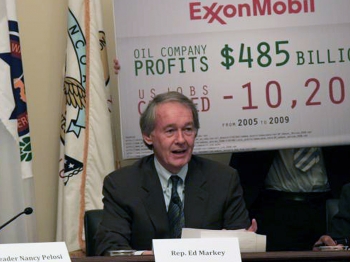
WASHINGTON—House Democrats took aim at oil companies Monday, arguing that billions in subsides for big oil would be put to better use in areas like clean energy technology and education.
“For too long we have given huge subsidies to the big five oil companies, increasing their profits and sending the bill to the American taxpayer,” said House Minority Leader Nancy Pelosi (D-Calif.) at a well-attended House Democratic Steering & Policy Committee hearing Monday.
During the meeting, details emerged of how oil companies, after making record profits last year, are still getting tax breaks crafted in 1918, which were designed to offset production costs for the then-newly emerging industry.
Other subsidies, such as the Deep Water Royalty Relief Act, passed in 1995 when oil prices were just $18/barrel, is still in effect today, while prices are topping $100/barrel.
“Giving tax breaks to oil companies to drill for oil would be like subsidizing a fish to swim or a bird to fly,” said Congressman Edward Markey (D-Mass).
Rep. Markey was co-author, together with Henry Waxman (D-Calif.), of the Clean Energy and Securities Act of 2009, which proposed a cap and trade system on carbon, and after intense debate failed to pass Congress.
A U.S. Government and Accountability Office (GAO) report released this week has singled out the oil and gas resource industries management as the biggest area of concern for this two-year period.
GAO found data on production of oil and gas from federal leases missing, as well as inconsistent data collection on the reporting of the sale of oil and gas.
In 2008, the GAO reported that the United States ranks 104 out of 115 oil and gas producers for revenues collected from these resources.
“We are essentially giving away up to $50 bill to oil companies that are taking home record profits,” said Elijah Cummings (D-Md.).
In early February, an amendment proposed by democrats, led by Markey, to eliminate royalty-free drilling in the Gulf of Mexico, was voted down 251–174.
President Obama, in his 2012 budget has proposed eliminating subsidies for oil and gas companies.
“For too long we have given huge subsidies to the big five oil companies, increasing their profits and sending the bill to the American taxpayer,” said House Minority Leader Nancy Pelosi (D-Calif.) at a well-attended House Democratic Steering & Policy Committee hearing Monday.
During the meeting, details emerged of how oil companies, after making record profits last year, are still getting tax breaks crafted in 1918, which were designed to offset production costs for the then-newly emerging industry.
Other subsidies, such as the Deep Water Royalty Relief Act, passed in 1995 when oil prices were just $18/barrel, is still in effect today, while prices are topping $100/barrel.
“Giving tax breaks to oil companies to drill for oil would be like subsidizing a fish to swim or a bird to fly,” said Congressman Edward Markey (D-Mass).
Rep. Markey was co-author, together with Henry Waxman (D-Calif.), of the Clean Energy and Securities Act of 2009, which proposed a cap and trade system on carbon, and after intense debate failed to pass Congress.
A U.S. Government and Accountability Office (GAO) report released this week has singled out the oil and gas resource industries management as the biggest area of concern for this two-year period.
GAO found data on production of oil and gas from federal leases missing, as well as inconsistent data collection on the reporting of the sale of oil and gas.
In 2008, the GAO reported that the United States ranks 104 out of 115 oil and gas producers for revenues collected from these resources.
“We are essentially giving away up to $50 bill to oil companies that are taking home record profits,” said Elijah Cummings (D-Md.).
In early February, an amendment proposed by democrats, led by Markey, to eliminate royalty-free drilling in the Gulf of Mexico, was voted down 251–174.
President Obama, in his 2012 budget has proposed eliminating subsidies for oil and gas companies.