A new OECD working paper shows that Australia’s renters face one of the most perilous markets of the 38 member countries, second only to Iceland.
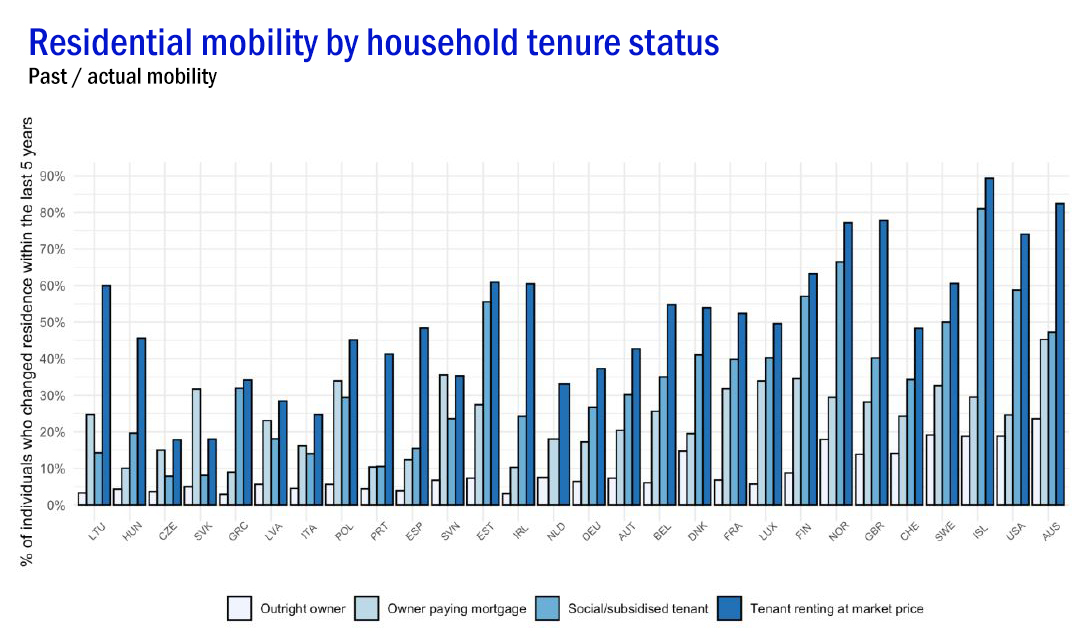
Eighty percent of renters have moved within the past five years, and the report places the blame squarely on government policies.
It warns that policies designed to protect tenants can have the opposite effect. In Australia, private renters are around 3.5 times more mobile (likely to move) than outright owners.
“Residential mobility is lower among households receiving a subsidy or paying below-market rents as compared to private tenants in most countries,” the paper notes.
While this means those people are more secure, and under less stress, such measures need to be carefully designed to avoid “locking-in effects,” in which people who could improve their circumstances opt not to because the savings from cheaper rent outweigh the benefits.
That can be avoided, the authors say, through “labour market policies that help the unemployed find good jobs, including job-counselling and well-designed training and requalification programs,” whereas regulating to control rents only reduces supply.

Higher public spending on housing allowances and social housing costs are strongly linked to people being more likely to move, the report found.
Unemployed people are less likely to move than those with jobs because they often can’t afford the costs of moving or job hunting.
The researchers suggest that increasing unemployment benefits could help job seekers cover these costs, making it easier for them to move for work.
Such a policy would outweigh the negative effects whereby higher unemployment benefits may reduce incentives to move for a job, the researchers say.
And those working but on low incomes in Australia and the UK are less mobile than those on high incomes, meaning the working poor seem to have reasonable security.
However, households that have changed residence in the recent past are found to be more likely to expect to change residence again—indicating those tenants don’t feel secure.
Negative Repercussions of Restrictive Rules
On the other hand, “excessive protection” of tenants can have negative repercussions, as landlords will often respond by rejecting applications from young people with insecure work to ensure the security of rent payments and minimal turnover so a property isn’t left vacant too often.“Rent control and tenant protection measures affect disproportionately low-income households as well as low and middle educated ones,” the research says.
“Those are the least mobile categories to start with, which implies that too restrictive rental market regulations may unintendedly constitute an additional barrier to the mobility of the least mobile groups.”

The report says such “negative effects on mobility are particularly pronounced in Australia,” where homeowners are 40 percentage points less likely to move than renters.
The report predicts that increased spending on housing allowances and social housing would increase mobility by around 12 percent.
Retreating Landlords Affecting Renters
Separate research by the Australian Housing and Urban Research Institute (AHURI) found there are many reasons for rental insecurity, but an important one is landlord churn, with most landlords and rental properties exiting the sector within five years.While the rental stock overseas is owned by large companies, 70 percent of landlords in Australia own just one property, and because it represents a large proportion of the landlord’s wealth, it will need to be sold when their financial position changes. Short leases and evictions are the result.
The entry of large numbers of institutional buyers into market, however, was found to push up the price of the average home by $49,950—clearly a negative for the average homebuyer.
Australian data in the OECD study came from the Household, Income and Labour Dynamics in Australia (HILDA) survey. Data from those under 24 and over 66 years old are excluded.